
Which cuisines conquered the world, and how they did it
What 340,000 restaurants across 22 countries say about how food travels.
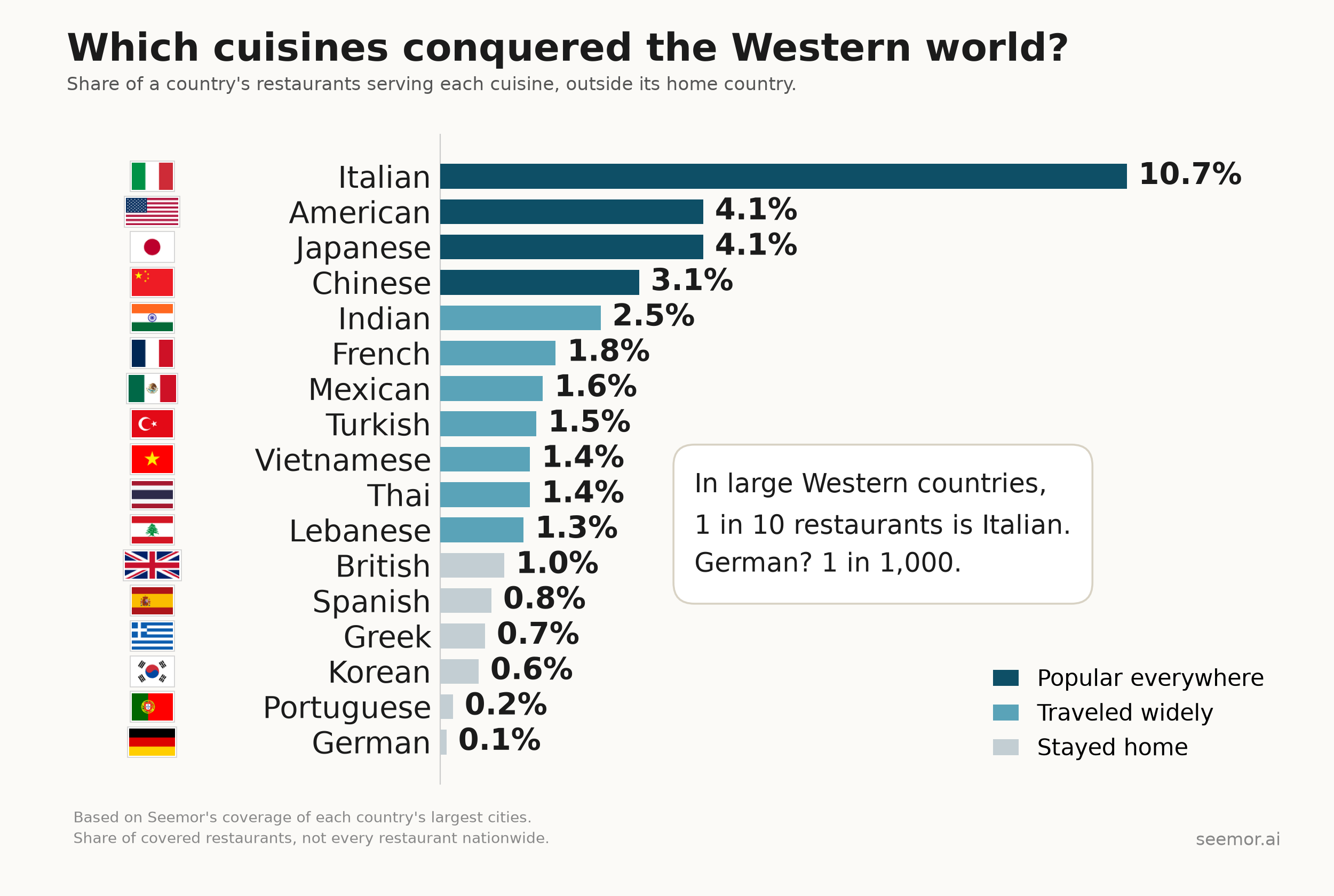
Wherever I go, there's an Italian restaurant. Buenos Aires, Copenhagen, a small town in Spain. There's always an Italian place, and it's usually decent. On the other hand, I've almost never walked past a German restaurant outside of Germany.
That's actually pretty strange when you stop to think about it. Germany is one of the largest economies on earth. Its food is hearty, specific, and beloved by the people who grew up on it. And yet it travels almost nowhere. Italian food, from a country a third the size, is the closest thing the planet has to a default.
I hadn't seen anyone try to quantify this before, and it got me thinking. Seemor has cuisine data across hundreds of thousands of restaurants in many countries, so an idle question turned into a real project. I took 17 of the world's best-known cuisines and measured what share of restaurants serve each one across roughly 340,000 restaurants in 22 countries, from the United States to Australia, Argentina to Sweden.
It turns out the results say more about culture, migration, and history than about cooking. Each map below shades the countries we cover by how much of their restaurant scene belongs to a given cuisine. Darker means more. The rankings are interesting on their own, but the stories behind the data turned out to be even more interesting than the data itself.
Italian won. It's not close.
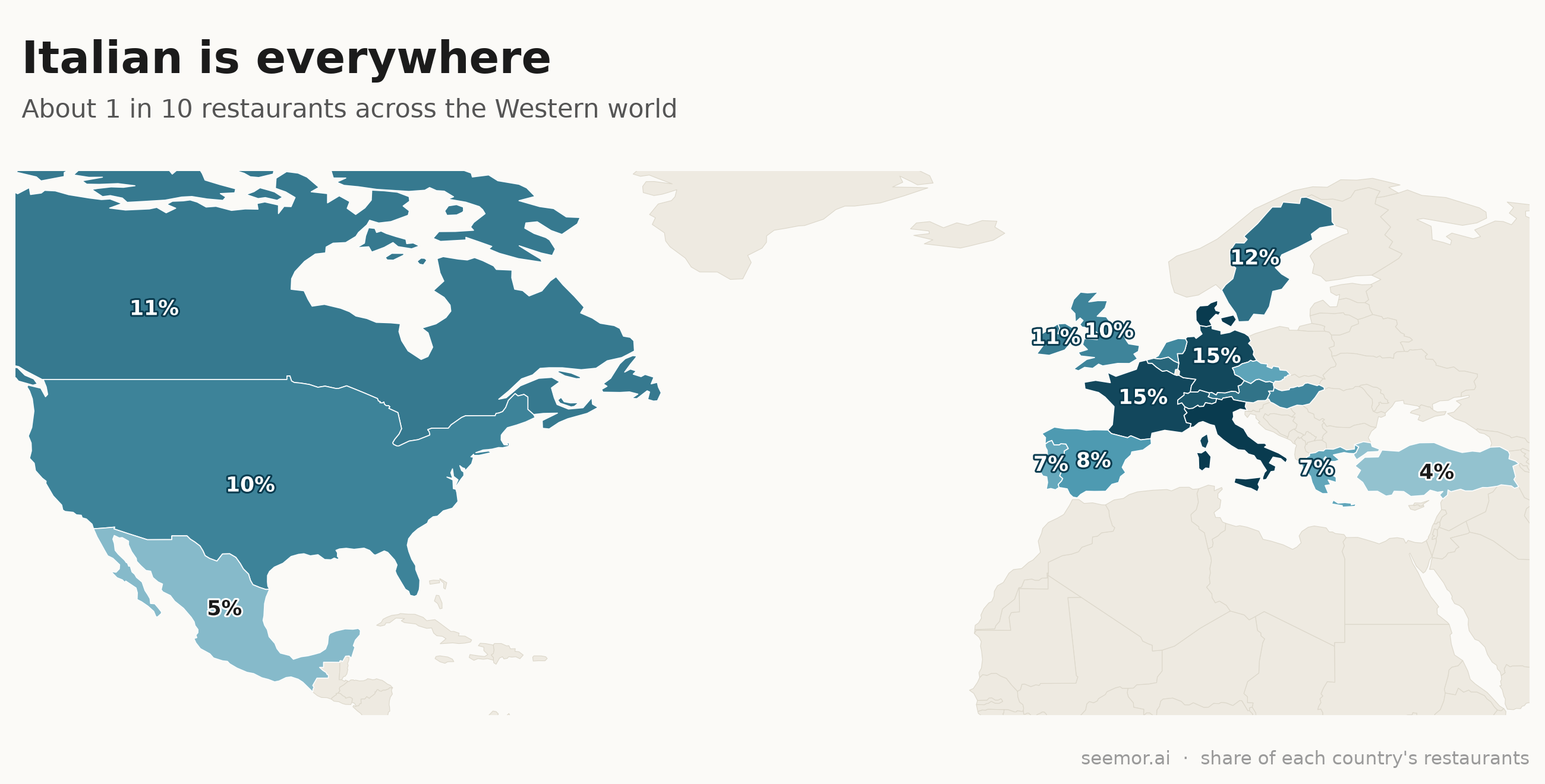
In a typical Western country, about 1 in 10 restaurants is Italian (excluding Italy). It's the most widespread cuisine by a wide margin, more than double the next on the list, and remarkably consistent from country to country. Denmark, France, Australia, Argentina: all somewhere around 10 to 18 percent Italian. Pizza and pasta stopped being foreign food a long time ago. They're just food now. No grocery store shelves pasta in the "international" aisle.
Italian food is everywhere for the same reason it runs deepest in Argentina: people. Between 1880 and 1920, millions of Italians left for the Americas. Roughly two million went to Argentina alone. In most places Italians were one immigrant group among many. In Argentina they were close to the whole story, around 60 percent of arrivals in the peak years, which is why an estimated six in ten Argentines today carry some Italian ancestry. There, Italian food isn't foreign at all. It's just Argentine food. Around 18 percent of the country's restaurants are Italian, one of the deepest footholds any cuisine has anywhere in our data. That explains Argentina. Italian's reach everywhere else owes as much to the twentieth century as to migration: postwar America turned pizza and pasta into everyday food, and from there they spread as the kind of meal anyone, anywhere, might cook on a weeknight.
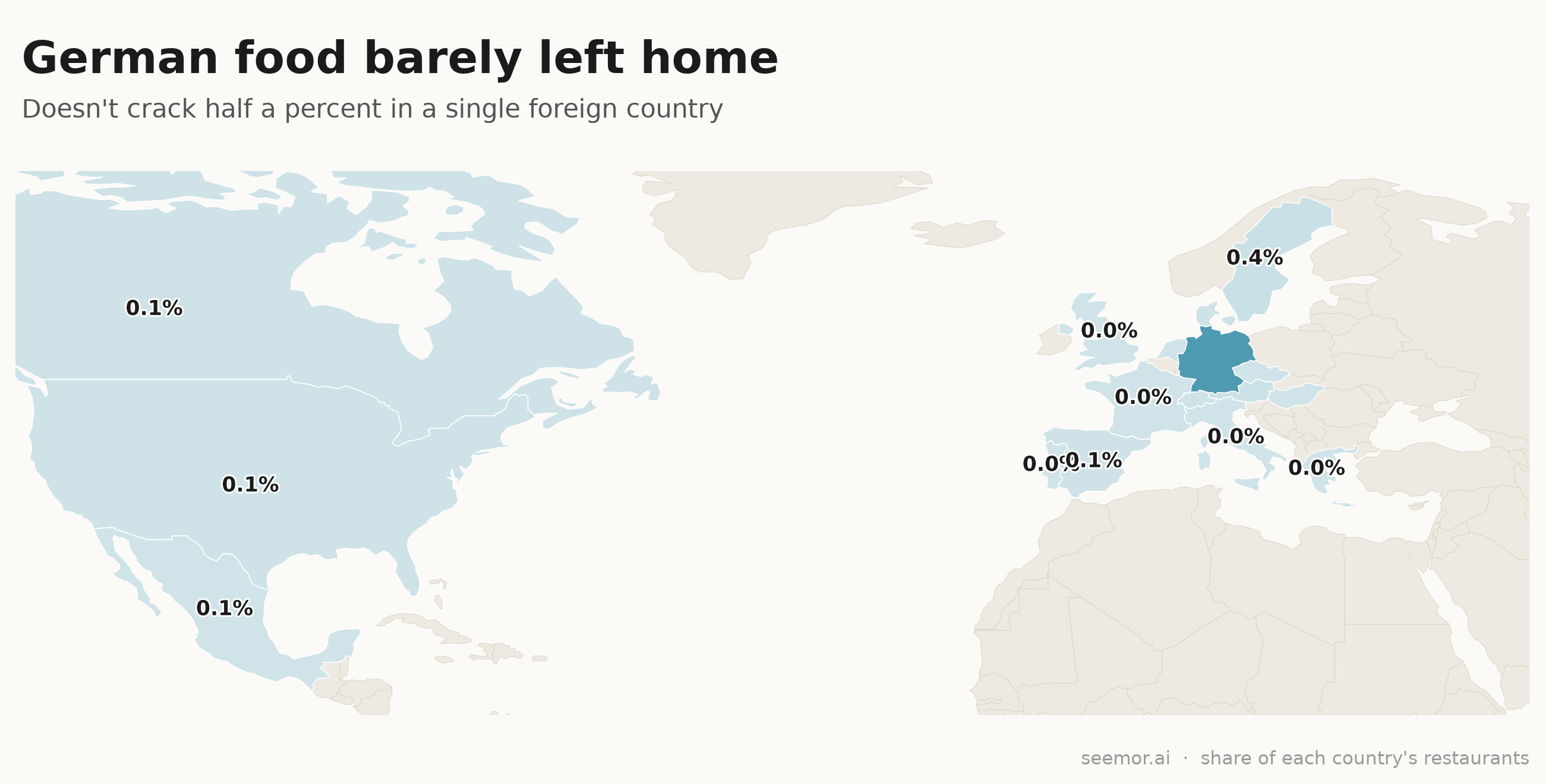
At the other end is German, which doesn't crack even half a percent of the restaurants in a single foreign country we cover. For German food, the figure is closer to 1 in 1,000 restaurants abroad. Schnitzel never really left home. The data is the data, but the German food story is more nuanced, as I'll get into below.
Everywhere, evenly: the cuisines that conquered
A handful of cuisines show up at similar levels almost everywhere you look. Italian is the clearest case, but it's not alone.
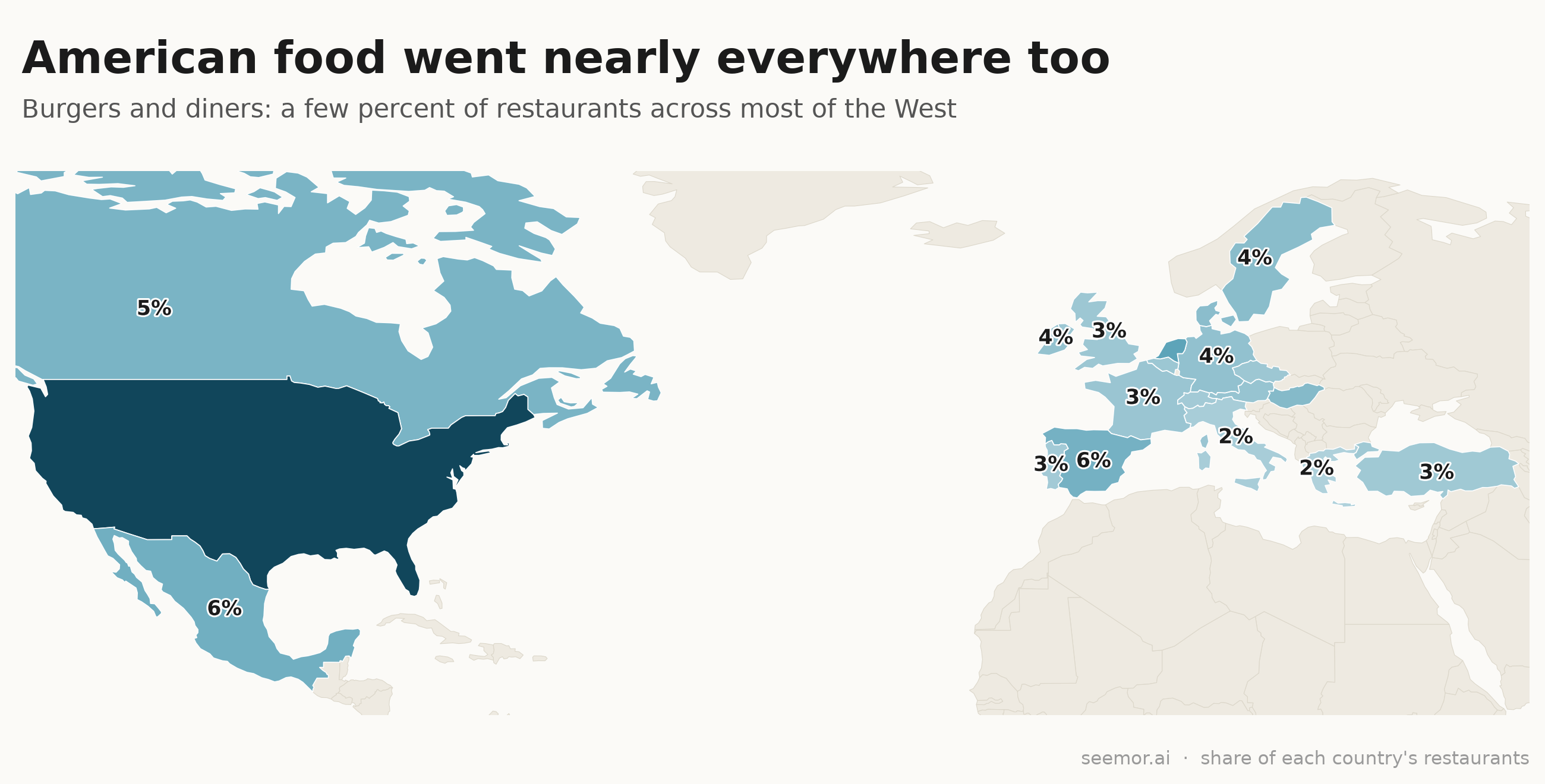
American is right behind it, tied with Japanese as the most widespread cuisine after Italian. It's also one of the most uniform: a few percent of restaurants in nearly every Western country. My first assumption was that this was just McDonald's and KFCs everywhere. It isn't. Fewer than one in ten "American" restaurants abroad are recognizable chains. The rest are independent burger joints and diners. The burger is America's most successful cultural export, and it didn't travel in fast-food franchises. It traveled as a style everyone decided to cook.
There's a historical wrinkle in this. The hamburger is named for Hamburg, Germany, and its ancestor, the Hamburg steak, came to America with German immigrants. So in a way, the one German dish that ever truly conquered the world had to stop being German to do it. Nobody ordering a cheeseburger nowadays thinks of it as German (but tell me if you disagree).
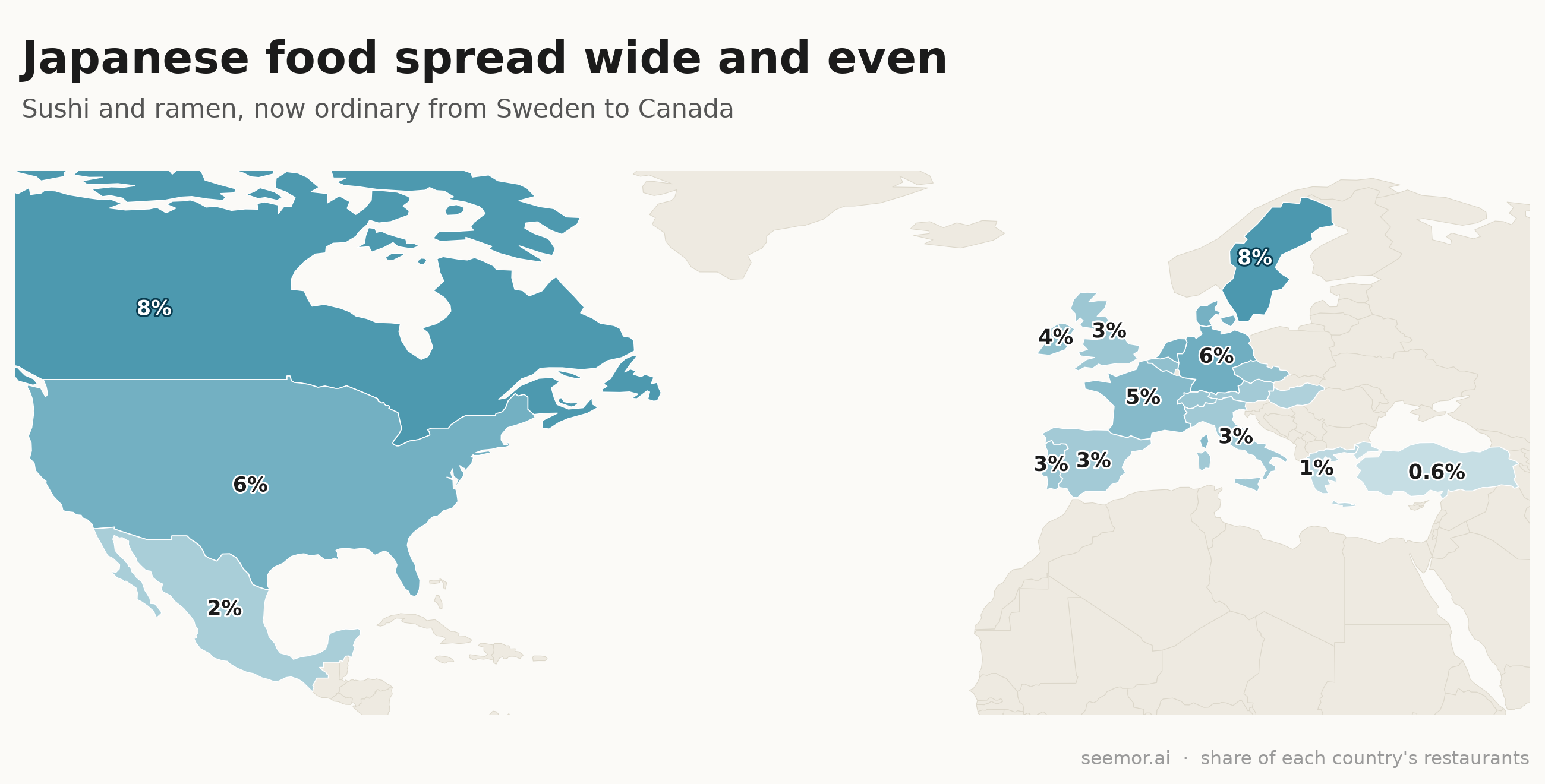
Japanese was another surprise in the top tier. It's now tied with American as the most widespread cuisine after Italian, and it reaches even further: it clears a meaningful share in all 22 countries we looked at. Sushi and ramen were exotic in the West within living memory. Today they're ordinary, turning up as far apart as Sweden and Canada.
The path is well documented. The first American sushi bars opened in the 1960s in Los Angeles's Little Tokyo, serving Japanese businessmen before their American colleagues acquired the taste. The California roll, which swapped avocado for hard-to-source fatty tuna, followed in the early 1970s and made the whole thing approachable. The 1980s turned curiosity into a boom. And by the 1990s, casual chains like London's Wagamama and Yo! Sushi had turned a bowl of ramen or a plate of conveyor-belt sushi into an ordinary night out in Britain. Fast-forward to today and Japanese is tied for the second most common cuisine in most Western countries.
Unlike Italian or Chinese, Japanese food didn't ride a great migration. A small community in places like LA's Little Tokyo opened the first doors, but what carried sushi into every country we cover was demand. People simply decided they wanted it.
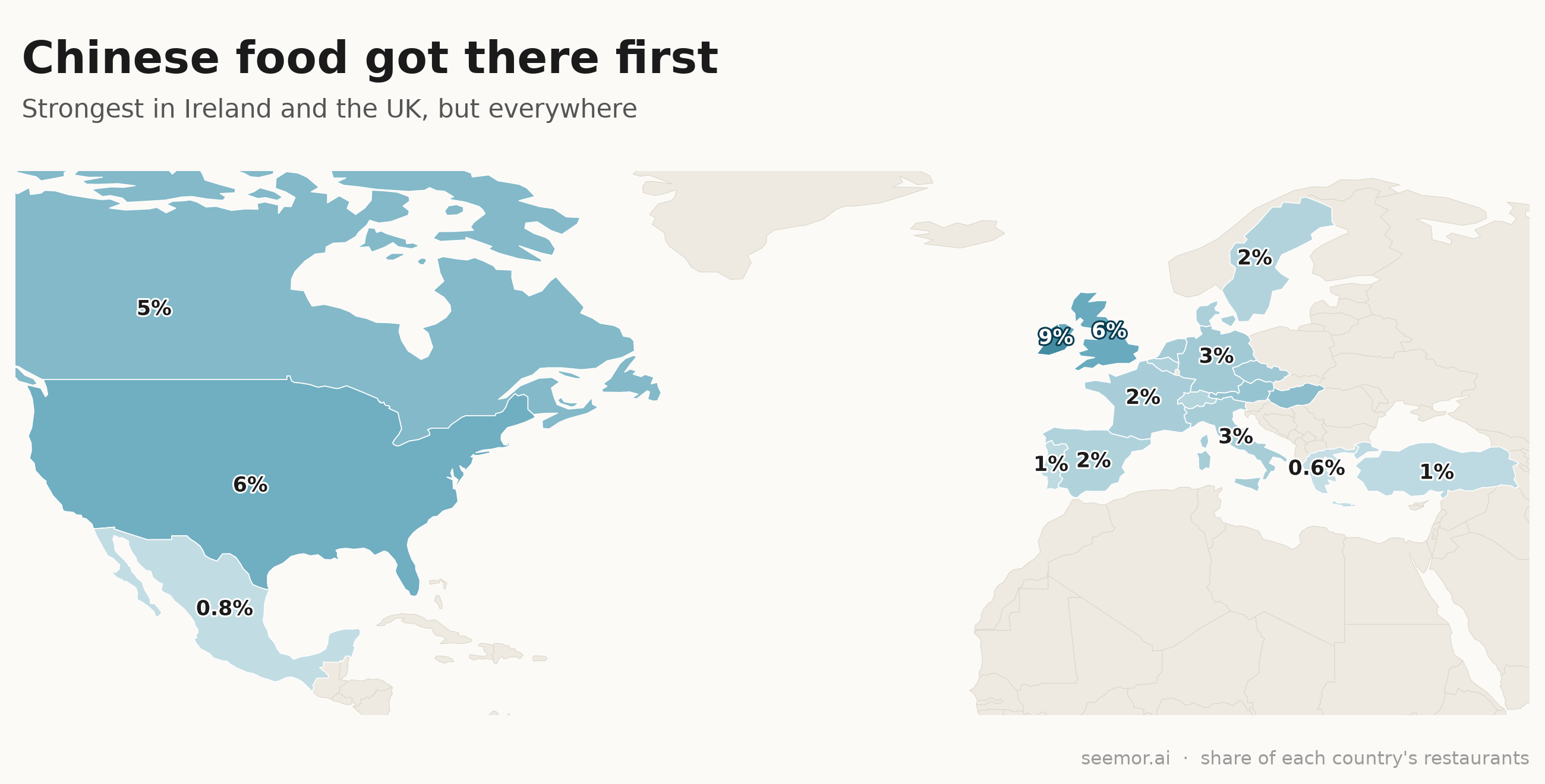
Chinese food comes in third on average and is just as universal. Like Japanese, it turns up in every country we measured, but where Japanese is even, Chinese spikes: nearly 1 in 10 restaurants in Ireland, and a heavy presence across the United Kingdom and United States.
It also traveled earlier than almost anything else on this list. Cantonese migrants carried it around the world through the nineteenth century, decades before Japanese or Thai food registered in the West at all. It reached San Francisco during the Gold Rush of 1849 and grew outward from there; by around 1900, chop suey houses had moved Chinese food well beyond Chinatowns into ordinary American cities. The one place it didn't get to first was Britain, where Indian food beat it by a generation.
Following people: the cuisines that spread by migration
Other cuisines didn't spread evenly. They concentrated, and where they concentrated tells you a story. Each of their maps is really a migration map drawn in restaurants.
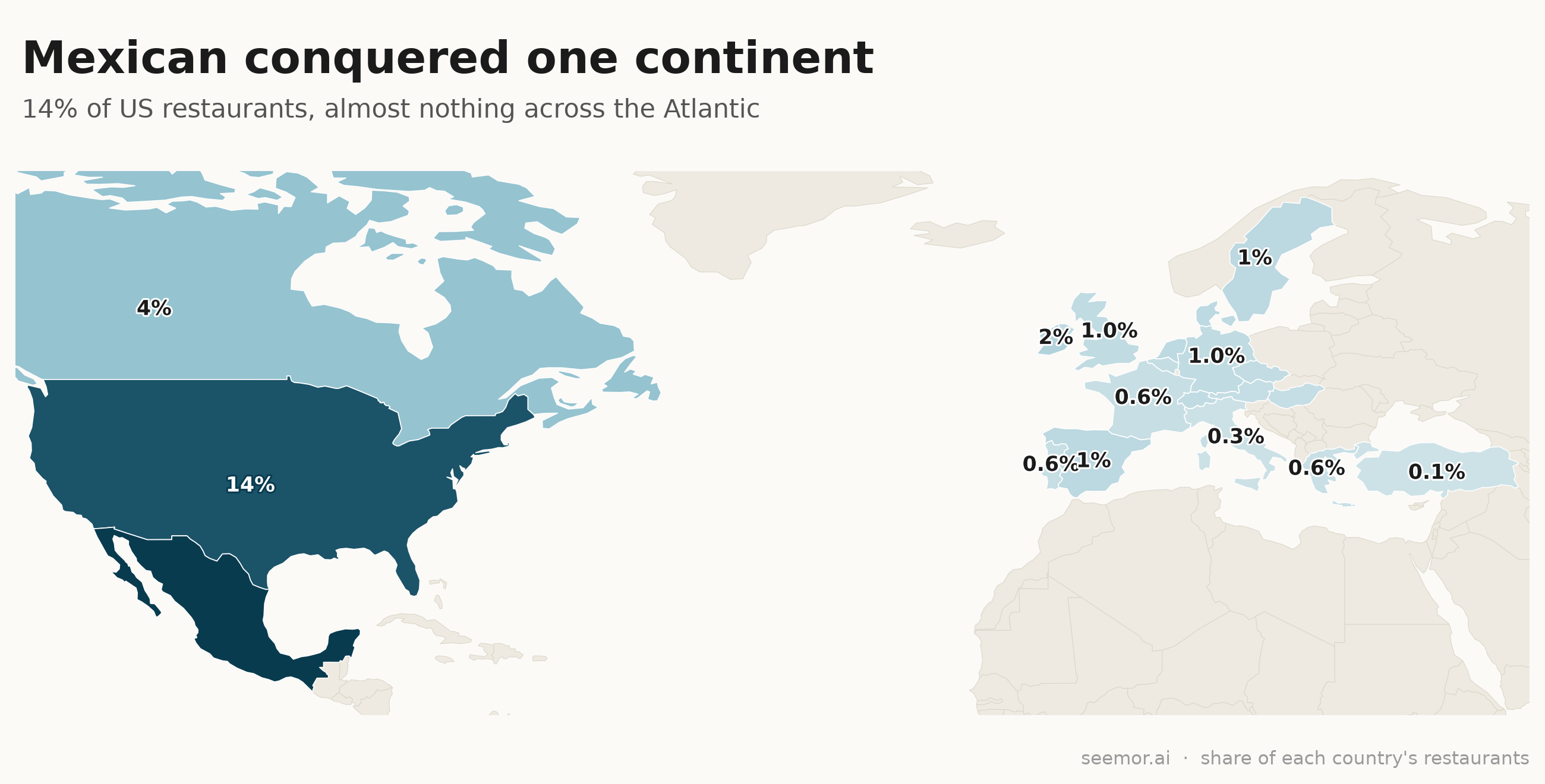
Mexican is the most concentrated cuisine in the entire dataset. Nearly 14 percent of restaurants in the United States are Mexican. Cross the Atlantic and it all but disappears. It conquered one part of the world completely and barely touched the rest.
The reason is a border that moved before the people did. When the United States annexed the northern third of Mexico in 1848, it absorbed a Mexican population and its kitchens. Later waves of migration deepened the footprint, and a homegrown offshoot, Tex-Mex, carried it across the country. Europe never got the migration, so the food never made the crossing. Fittingly, the most American-Mexican dish of all, chili con carne, isn't Mexican at all. It was invented in Texas, and one Mexican dictionary reportedly dismissed it as a detestable dish wrongly described as Mexican.
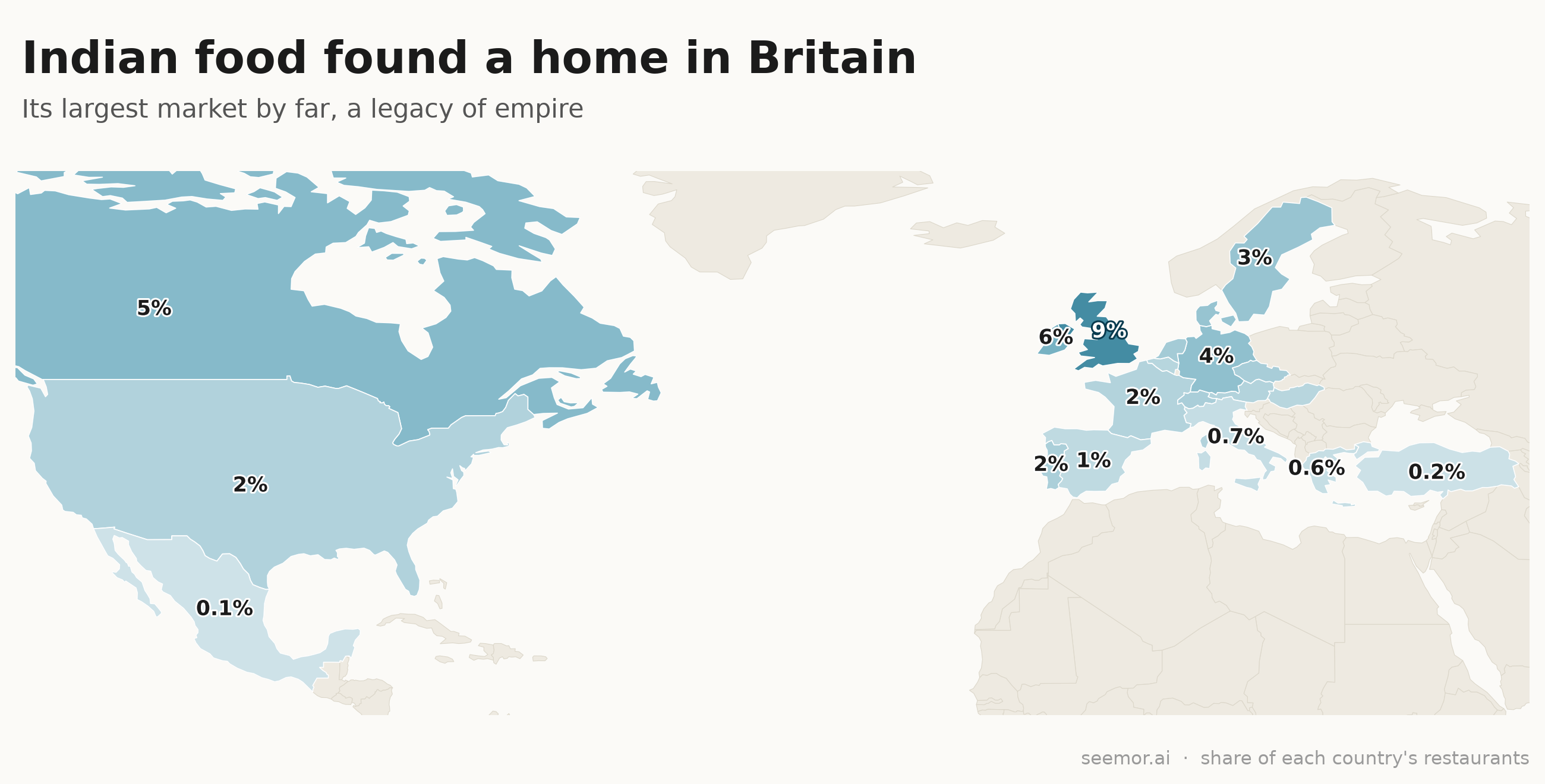
Indian food traced the map of the British Empire backwards. Its largest foreign market, by a wide margin, is the United Kingdom, where chicken tikka masala is sometimes called the national dish, and it runs deep across the old Commonwealth in Canada and Australia. It's strong next door in Ireland too, its second-largest foreign market, though that owes more to recent Celtic Tiger migration than to empire.
There's a familiar wrinkle here too. Chicken tikka masala was most likely invented in Britain, by a South Asian cook adapting tandoori chicken for a country that wanted gravy with it. (There's a famous origin story about a Glasgow restaurant and a tin of tomato soup, but even one of the people who spread that version later admitted he made the soup part up.) And the "Indian" restaurant itself is, more often than not, Bangladeshi. For decades the great majority of Britain's curry houses were run by immigrants from the Sylhet region of Bangladesh, not from India at all.
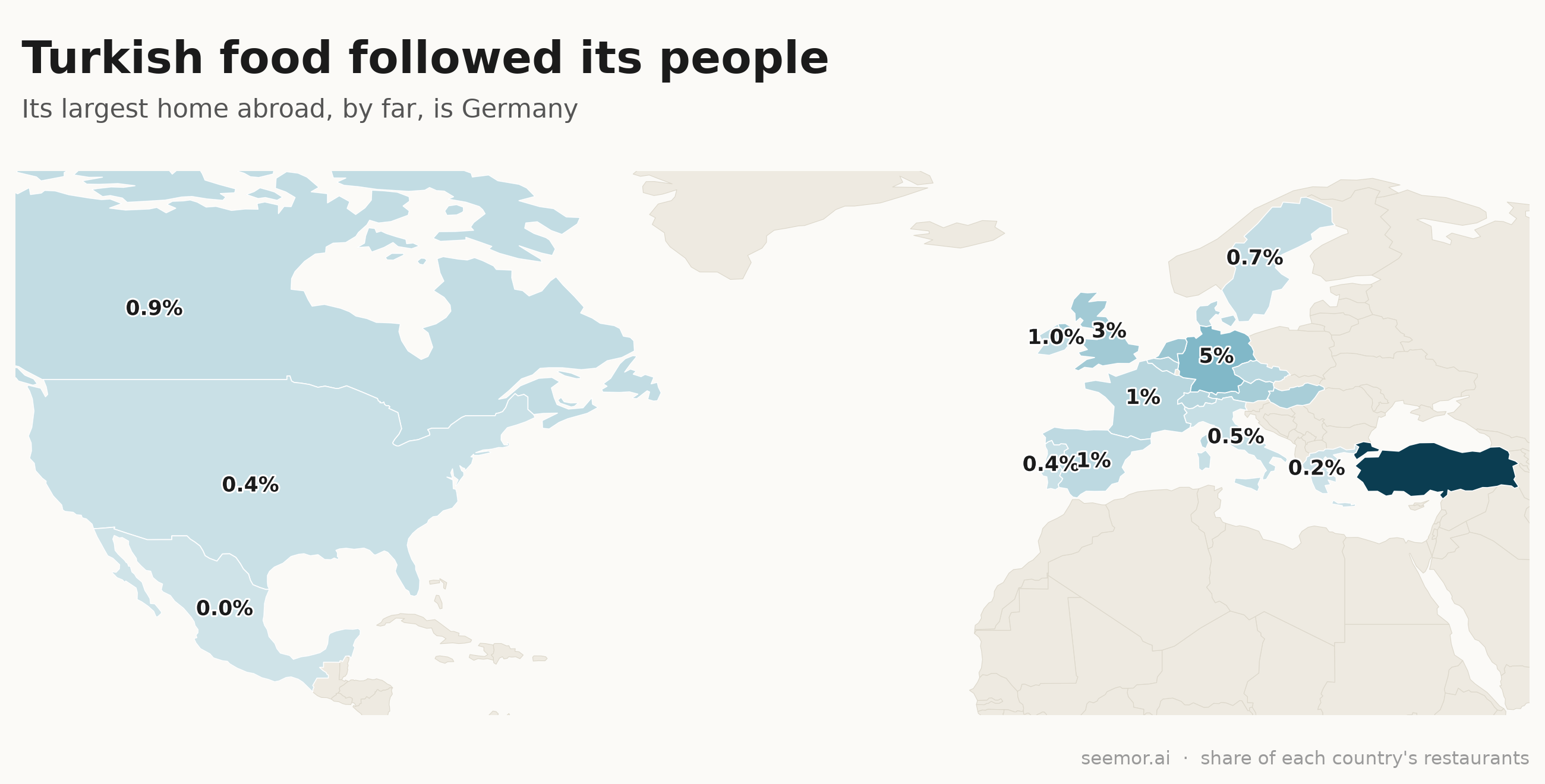
Turkish food's largest home abroad is Germany, where nearly 5 percent of restaurants are Turkish. That traces to a single decision: the 1961 guest-worker agreement that brought hundreds of thousands of Turkish workers to West Germany and left it with the largest Turkish population outside Turkey itself. And it produced the same twist as the hamburger. The vertical roasting spit is an old Ottoman invention, but the döner the world eats today was made famous in its modern form by Turkish immigrants in 1970s Berlin. It's now arguably Germany's national fast food: Germans pick it over currywurst, and when prices spiked in 2024 the cost of a döner was debated in the Bundestag.
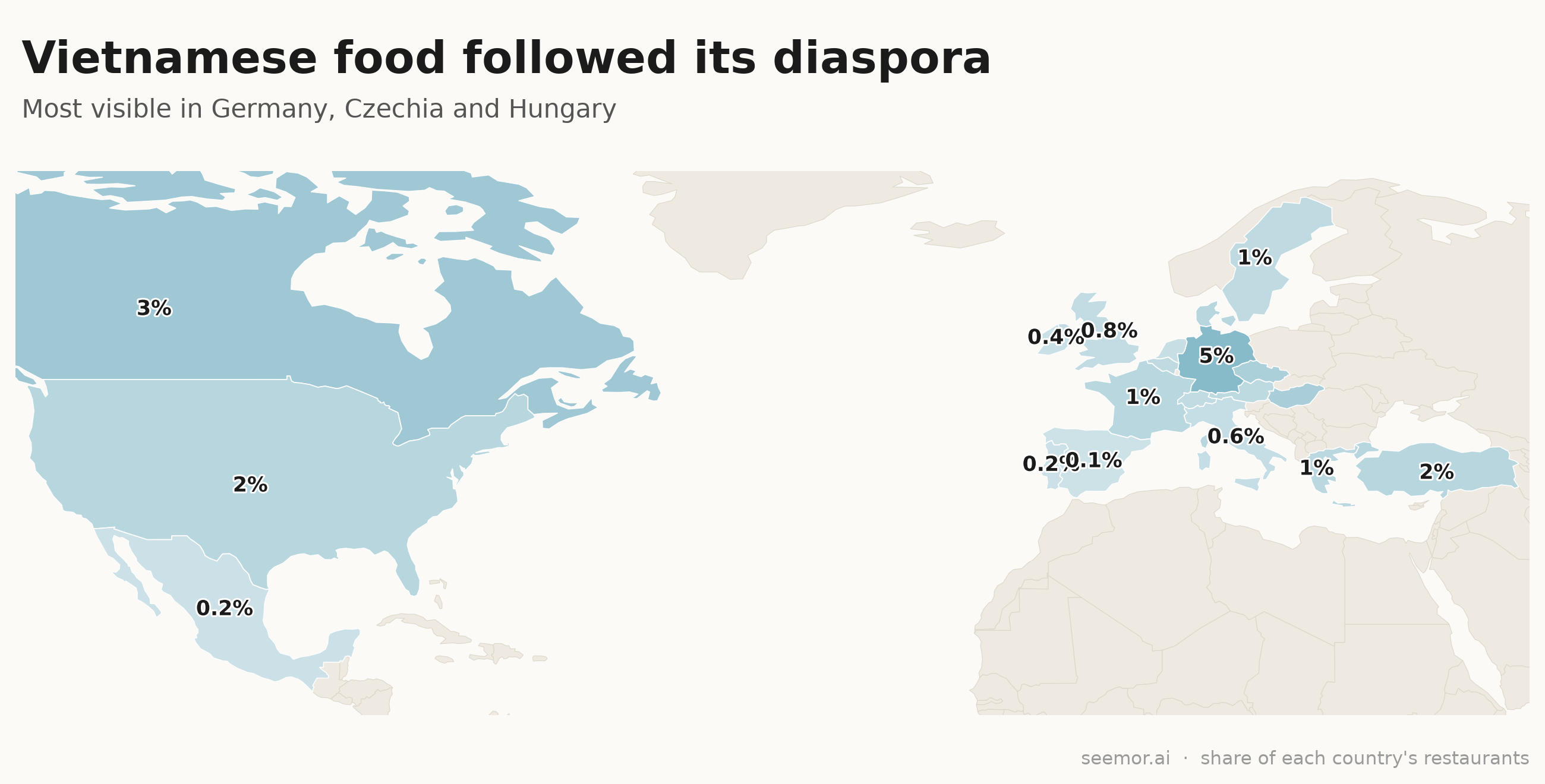
Vietnamese food clusters in Germany and across Central Europe, which isn't where the familiar story would put it. The diaspora the world knows is the post-1975 refugees, the boat people who resettled in the United States, France, and Australia. But Germany's Vietnamese presence has a different, Cold War root. In the 1980s, communist East Germany brought in tens of thousands of Vietnamese contract workers under a socialist labor pact, and the resident population grew from about 2,500 to nearly 60,000 in a decade. Many stayed after reunification, and the community they anchored in Berlin and the former East is why Vietnamese restaurants are a bigger share of the scene in Germany than almost anywhere we look.
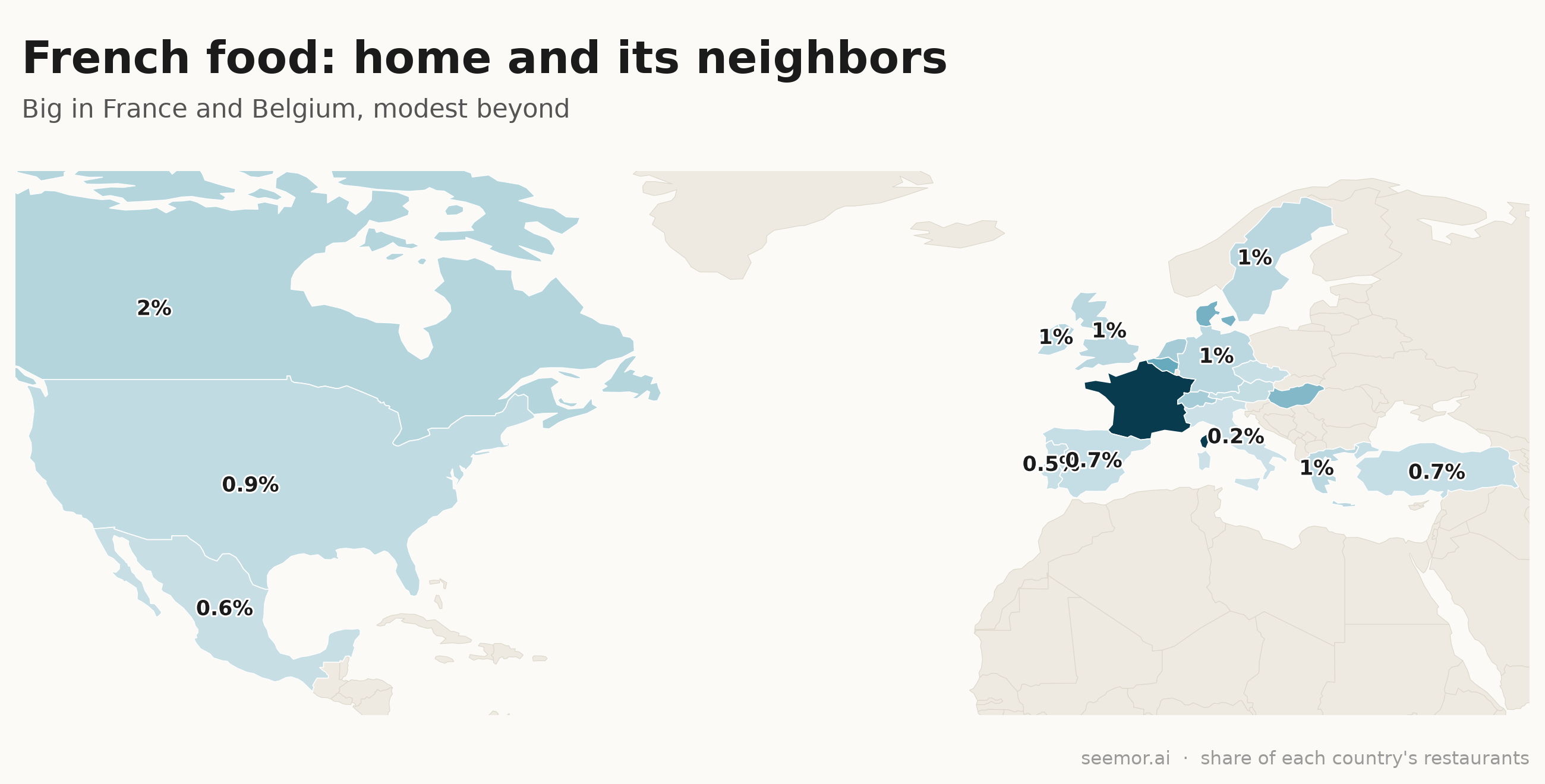
French food sits in between, widespread but never deep: big in France, strong in neighboring Belgium, modest most everywhere else. French food conquered the world's kitchens without conquering its streets. French technique is the grammar of professional cooking everywhere, the vocabulary on the line in every serious restaurant. But a "French restaurant" abroad usually means a special occasion, not a Tuesday, which keeps the numbers modest next to pizza or burgers. Influence isn't the same as reach. (Even some of France's icons are imports: the croissant descends from the Viennese kipferl, carried to Paris by an Austrian baker in the 1830s.)
Staying home: the cuisines that never really left
And then there are the cuisines that stayed put. German is the extreme case, but it has company.
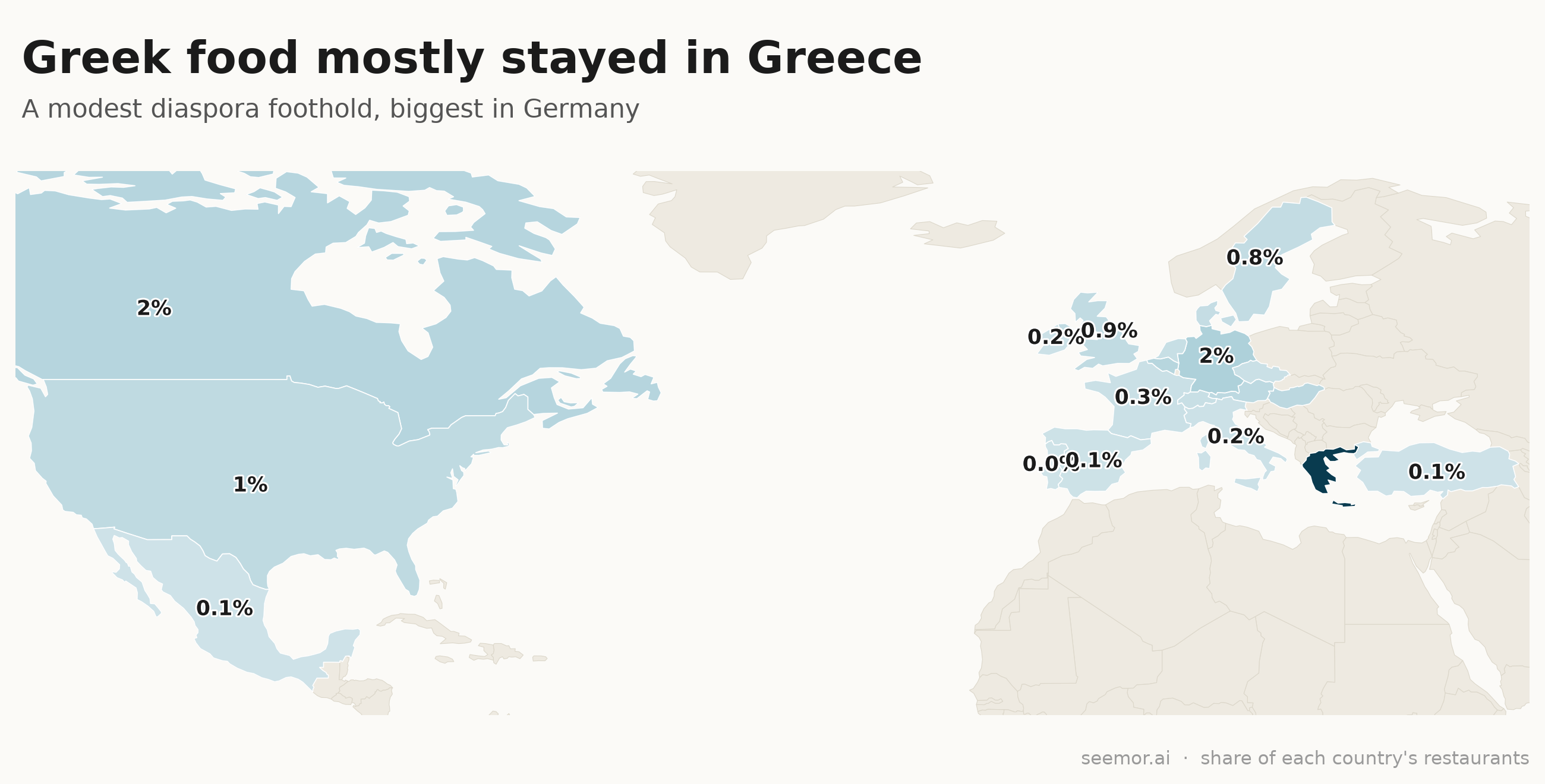
Greek food is beloved nearly everywhere but Greek restaurants are rare outside of Greece. Its footholds are small and tied to community: Germany, from the same 1960s guest-worker program that brought the Turks, and Australia, where Melbourne has one of the largest Greek populations of any city outside Greece. But the most interesting case is the United States, where Greek food conquered without using its own name. Greek immigrants went into the restaurant trade so thoroughly in the early twentieth century that they all but invented the American diner. They served burgers and eggs, not souvlaki, so the menu became American even as the people behind the counter were Greek. Greek cuisine never produced a pizza equivalent, something cheap and portable enough to get high distribution, so the gyro stayed Greek and the diner became ubiquitous.
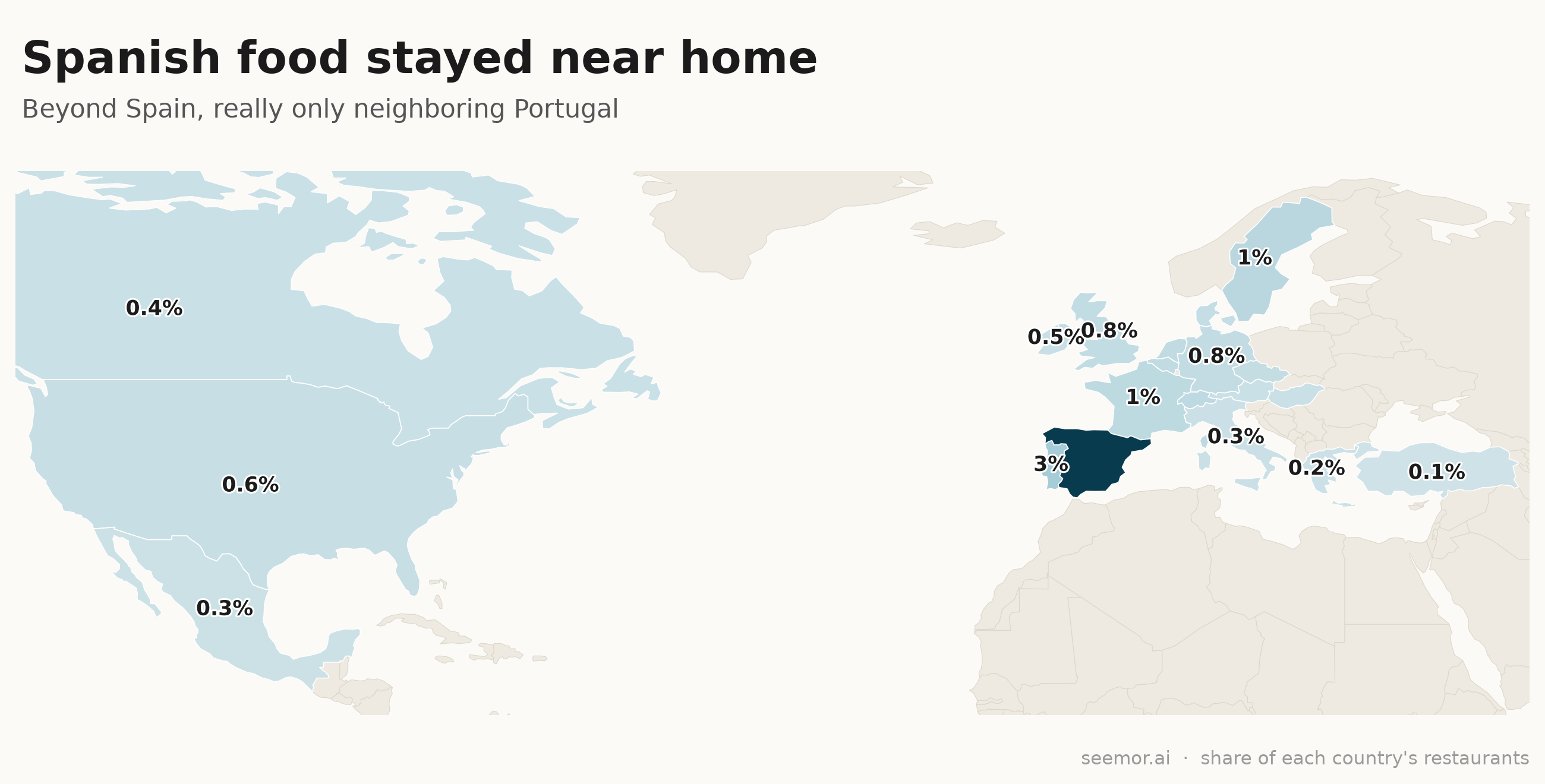
Spanish food barely leaves Spain, and its only real foreign foothold is neighboring Portugal, with which it shares a border and a lot of ingredients. That looks strange for a country with Spain's history until you see where Spanish food actually went. It went to the New World and became something else. The colonial legacy didn't travel as "Spanish restaurants" but as entirely new cuisines: Mexican, Argentine, Cuban, Peruvian, each its own thing now. Spanish emigration was real but smaller and later than Italy's, and tapas only went global in the last few decades. So the food stayed home while its descendants conquered continents under other names.
None of these are lesser cuisines. They're cuisines whose people, by and large, stayed home, or whose dishes never made the jump from heritage food to everyone's food.
When does a cuisine actually conquer?
Here's the pattern underneath the pattern. A cuisine that's concentrated in one or two countries is usually still tied to the people who brought it there. Turkish food in Germany is, to a large degree, food made by and for the Turkish community in Germany. Indian food in Britain carries the same history.
A cuisine has truly conquered when it loses that tie. When a Dane orders pizza or an Australian orders a burger, they're not reaching for someone else's heritage. They're ordering dinner. Italian and American didn't just travel farther than everyone else. They stopped being foreign.
That's the line, and only a handful of cuisines have crossed it. Most food, even food the whole world admires, stays close to home.
There's one last twist, and it belongs to the cuisine that seemed to lose. German food, despite the very small number of German restaurants outside of Germany, may have conquered more completely than any of them. Its restaurants never traveled, but its dishes did, and they blended in so well that we forgot where they came from. The hamburger and the hot dog trace to German immigrants. So does the delicatessen, and the American lager: Pabst, Schlitz, and Anheuser-Busch were all German-immigrant breweries. German food didn't fail to spread. It spread so completely that it stopped looking German, helped along by the world wars and Prohibition, which gave German-Americans every reason to stop advertising it. By the logic of this whole piece, that's not the consolation prize. It might be the purest version of the win: a cuisine that became so ordinary it disappeared into the food everyone already calls their own.
Everyone, in one chart
Here's the whole dataset in a single view. Cuisines run down the side, countries across the top, and each cell shows how much of that country's restaurant scene belongs to that cuisine. Read across a row to follow a cuisine; read down a column to see a country's taste.
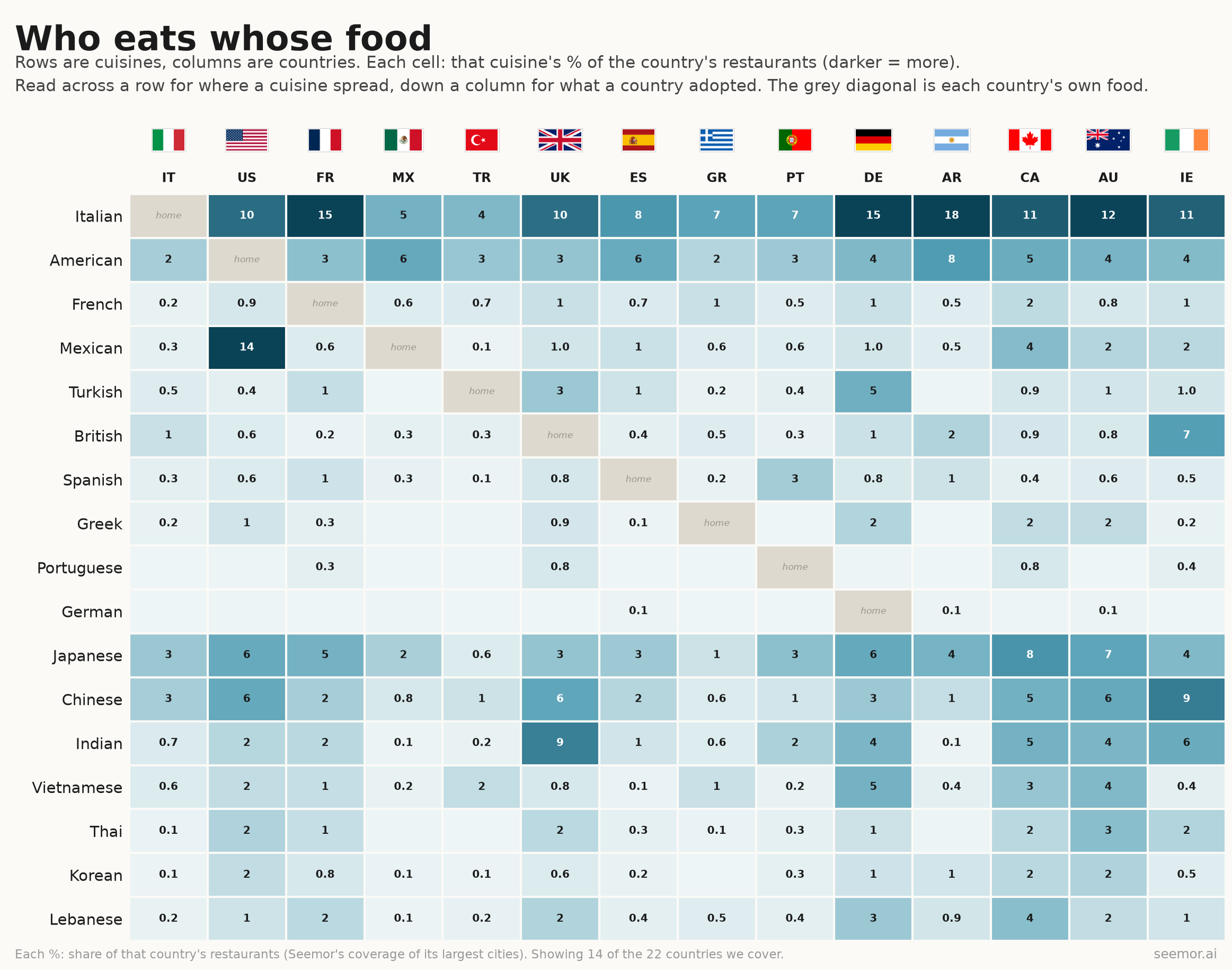
A few things jump out. The countries with the most diverse dining scenes (the United States, Germany, the United Kingdom, Australia) are busy with color. A few others, Italy, Turkey, Mexico, mostly eat their own food. Argentina's single darkest cell is Italian, at 18 percent, one of the deepest foreign footholds any cuisine has anywhere in the data. And the German row, near the bottom, is almost empty.
Some caveats
This isn't the full story of how far these cuisines have traveled. Our data covers major cities across 22 Western countries, so it's really the picture in the West. Asia isn't in here yet, which means cuisines like Korean or Thai are undersold, and we can't measure how far Asian cuisines have spread from home. Our coverage also centers on each country's largest cities, which tend to be more international than rural areas, so these are shares of the restaurants we cover, not a census of every restaurant in every country.
And reach isn't quality. None of this says German food is worse than Italian. It says German food stayed home, which is a fact about culture and history, not about how good the schnitzel is.
What the data does measure well is spread. And spread, it turns out, is a map of how people moved, who they brought their food to, and which dishes the rest of us quietly adopted as our own.
See what Seemor finds for you
Honest grades, personal scores, and 35+ dimensions of quality across 12 cities.
Try Seemor free