
Mexican vs Spanish Food: What 4,000 Restaurants Tell Us
My daughter's school debate, settled (sort of) by data.
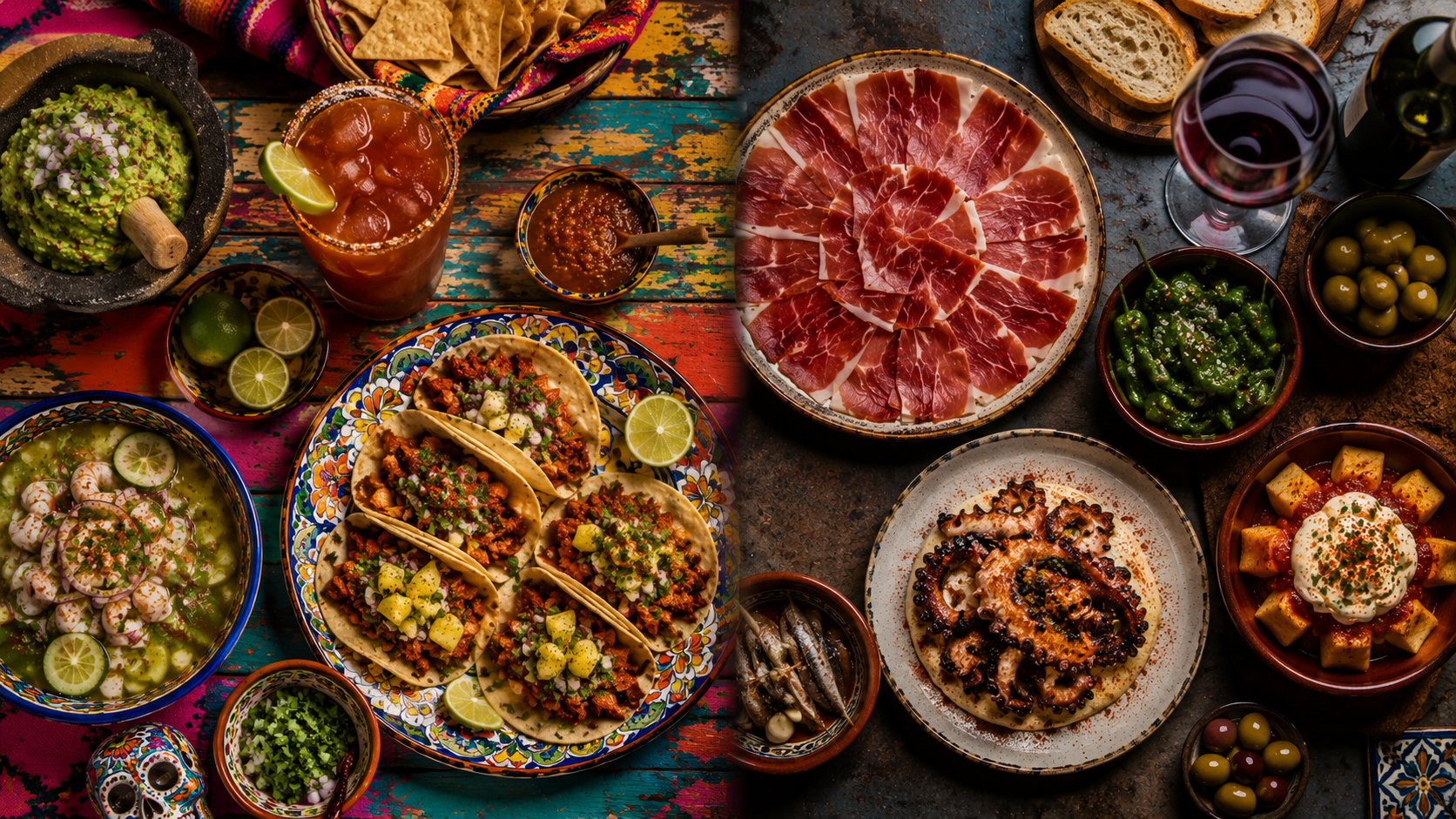
My daughter came home yesterday with a school debate assignment: Mexican food vs Spanish food. Which is better?
She's already picked her side (Mexican), and asked me if I had anything that could help her win. I told her I had dimensional quality data on over 42,000 restaurants across 85 cities, and about 4,000 of them are Mexican or Spanish. Her eyes glazed over immediately, which is fair. But I couldn't let it go, because this is actually a fascinating question when you look at it properly. Not "which is better" (that depends entirely on who you are), but "what is each cuisine actually good at?"
The London bias
Here's the thing about debating this in a London school: it's not a level playing field. Spain is a two-hour flight away. Mexico is twelve hours and an ocean. London has 109 analyzed Mexican restaurants and 84 Spanish ones, so it's not like Mexican food is hard to find. But the quality gap tells the story.
Spanish food in London scores 7.93 out of 10 on food quality. Mexican scores 7.60. That's a meaningful difference, and it gets worse on authenticity: Spanish food in London scores 7.6, Mexican only 6.5. London's Spanish restaurants are closer to what you'd get in Madrid. London's Mexican restaurants are further from what you'd get in, say, Los Angeles or Mexico City.
If most of her classmates are judging "Mexican food" by what's available in London, they're debating with one hand tied behind their back.
Head to head: the global picture
We analyzed 2,003 Mexican restaurants and 1,908 Spanish restaurants across 85 cities. Here's how they compare:
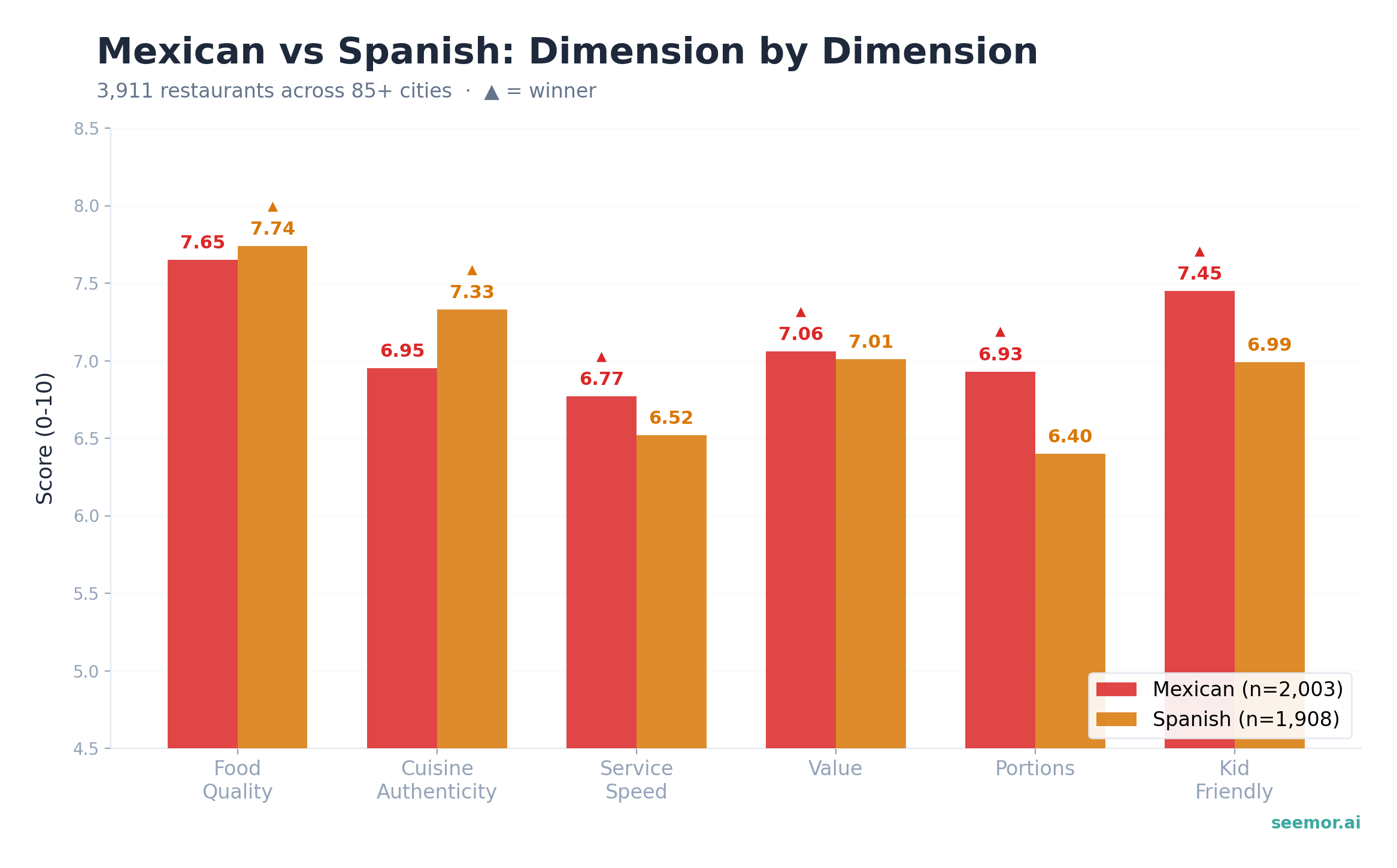
Spanish food scores higher on food quality (7.74 vs 7.65) and cuisine authenticity (7.33 vs 6.95). Spanish restaurants also edge ahead on ambiance design (6.89 vs 6.58) and service knowledge (7.14 vs 6.87). The staff tend to know more about what they're serving, the spaces are more architecturally considered, and the cooking is (on average) a touch more polished.
Mexican food wins on the dimensions that a lot of people actually care about day to day. Portions (6.93 vs 6.40) is the biggest gap in the entire comparison. Tapas culture means smaller plates by design, which isn't a flaw, but it is a real difference. Mexican restaurants are also faster (service speed 6.77 vs 6.52), better value (7.06 vs 7.01), and significantly more kid friendly (7.45 vs 6.99). If you're sixteen and hungry, or taking your kids somewhere that won't make everyone stressed, Mexican restaurants win that one and it's not close.
The grade gap
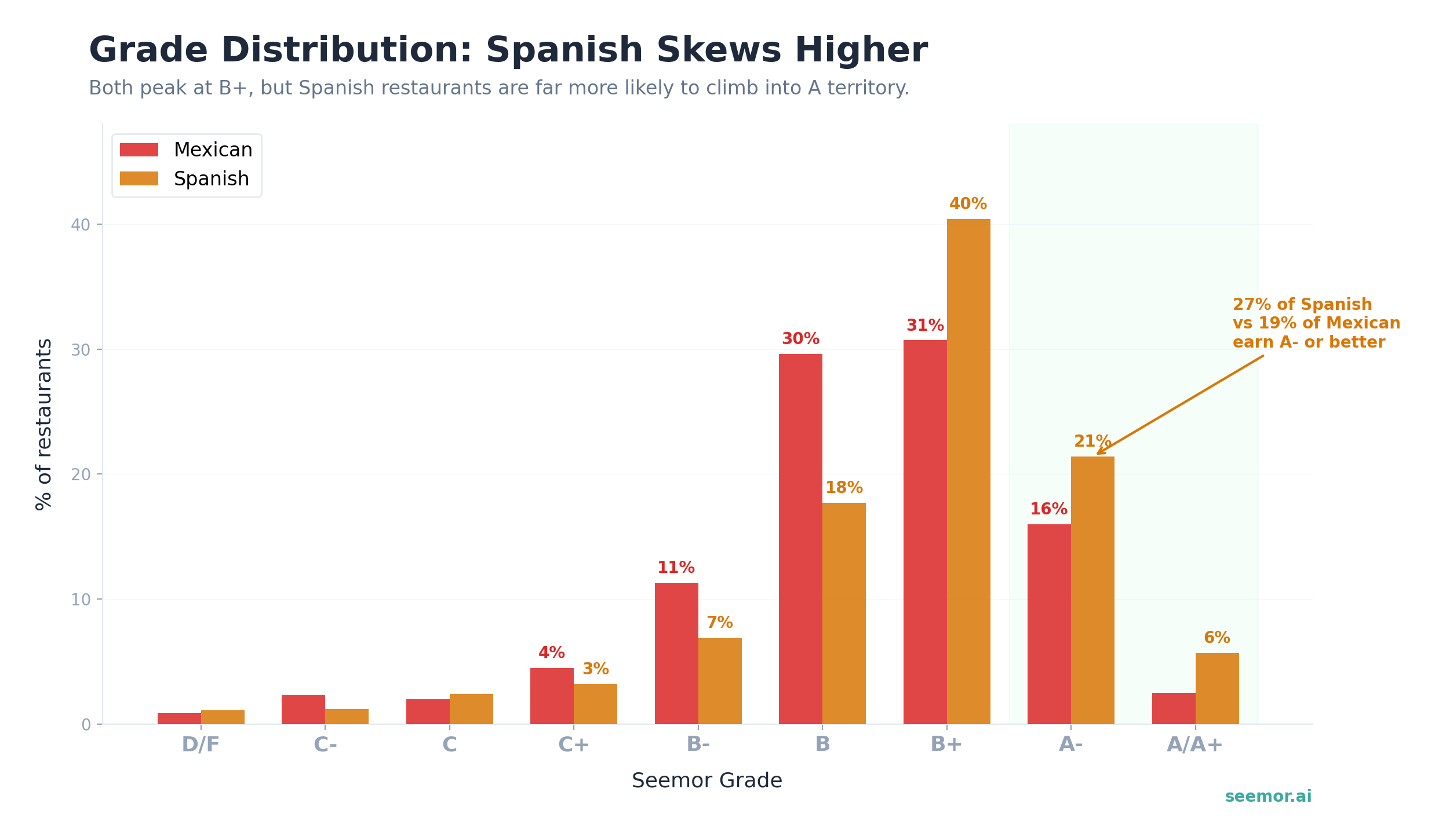
When we convert all of those dimensional scores into letter grades (A+ through F), the distribution shows a clear shift:
| Grade | Mexican | Spanish |
|---|---|---|
| A- or better | 18.6% | 27.1% |
| B+ | 30.7% | 40.4% |
| B or below | 50.7% | 32.5% |
Spanish restaurants are significantly more likely to land in the A range. Over a quarter of Spanish restaurants earn an A- or better, compared to less than a fifth of Mexican. The peak for both cuisines is B+, but Spanish restaurants pile up there more heavily (40% vs 31%) and are much more likely to keep climbing into A- territory. Mexican restaurants spread more evenly across B and B+, with a longer tail into the C grades.
But wait. Check the home turf.
Here's where it gets interesting. The global numbers are skewed by geography. Most of the Spanish restaurants in our dataset are in Spain itself, where authenticity comes naturally. Spanish food outside of Spain is relatively rare. There are only 4 Spanish restaurants in all of Los Angeles, 5 in Chicago. It barely exists in most American cities.
Mexican food is the opposite story. It's everywhere in the US (which shares a 2,000-mile border with Mexico) and the quality holds up. Mexican food in Chicago scores 7.80 on food quality. San Francisco, 7.73. Los Angeles, 7.74. These aren't far-flung outposts struggling with authenticity. They're cities with deep Mexican culinary traditions and large Mexican communities. Mexican food in the US is fantastic.
Where Mexican food struggles is in Europe. London (7.60), Munich (7.03), Budapest (7.01). The further you get from the Americas, the more the quality and authenticity drop. This is what drags down the global averages.
Mexican food in Mexico itself (Puerto Vallarta, Cabo San Lucas, San José del Cabo) averages 7.7 to 7.85 on food quality. Spanish food in Spain (Madrid, Barcelona, Marbella) averages 7.65 to 7.75. On home turf, Mexican food slightly edges Spanish on raw food quality.
Spanish food, meanwhile, performs almost as well in London (7.93) as it does in Barcelona (7.74). Actually, that's not a typo. Spanish food in London scores higher than in Barcelona. London's Spanish restaurants are curated. Barcelona has 499 of them, and the average gets diluted. London has 82, and they tend to be good.
Where each cuisine dominates
The prevalence data tells its own story about cultural reach:
| City | Mexican | Spanish |
|---|---|---|
| Madrid | 59 | 528 |
| Barcelona | 27 | 499 |
| London | 109 | 84 |
| Los Angeles | 159 | 4 |
| Chicago | 111 | 5 |
| New York | 107 | 35 |
| San Francisco | 90 | 12 |
| Paris | 17 | 16 |
| Edinburgh | 8 | 14 |
In the US, Mexican food is everywhere and Spanish food is almost nonexistent. In Spain (obviously), the reverse. London and Paris are the rare cities where both cuisines have meaningful presence, which is part of why this is a more interesting debate in London than almost anywhere else.
The real comparison: authentic vs authentic
Here's the question that actually matters. The global numbers include everything from a faithful family-run taqueria to a London burrito chain calling itself "Mexican." That's not a fair fight. What happens if we only compare restaurants where the cuisine is being done authentically?
We scored every restaurant on cuisine authenticity (how true it stays to its culinary tradition). When we filter to only high-authenticity restaurants (8 out of 10 or above), the sample sizes are nearly identical: 353 Mexican, 333 Spanish. And the food quality gap disappears.
| Dimension | Mexican (n=353) | Spanish (n=333) |
|---|---|---|
| Food Quality | 8.05 | 8.03 |
| Consistency | 6.92 | 6.89 |
| Service | 7.39 | 7.37 |
| Value | 7.43 | 7.27 |
| Portions | 7.02 | 6.70 |
Authentic Mexican food and authentic Spanish food produce essentially the same quality of cooking. The 0.09 gap in the global numbers vanishes. Meanwhile, Mexican food's advantages on value and portions persist even at the highest levels of authenticity.
So why does Spanish food look better in the global numbers? Because there are a lot of mediocre "Mexican" restaurants out there that aren't really Mexican. We found 182 low-authenticity Mexican restaurants versus only 27 low-authenticity Spanish ones. Spanish food doesn't get diluted the same way, partly because it's less ubiquitous outside Spain and partly because tapas is harder to fake than a burrito.
This is probably the most important finding in the whole analysis. Spanish food doesn't actually taste better. It just travels with its authenticity intact more often.
What's interesting is that the differences that do persist at high authenticity aren't really about cooking skill. They're about cultural values. Authentic Mexican restaurants are more generous with portions, faster, better value, more welcoming to kids. Authentic Spanish restaurants are more polished in design, more knowledgeable about wine, more considered in presentation. You're not comparing two kitchens. You're comparing two cultures' relationships with food, hospitality, and what a meal is supposed to be. Neither is better. They just care about different things.
That might be the most interesting use of this kind of data. Not "which restaurant is best" but "what does a cuisine's pattern of strengths and weaknesses tell you about the culture it comes from?" We're going to keep pulling on that thread.
At the very top
The best of each cuisine tells you something about their character.
The highest-graded Mexican restaurant in our dataset is Cariño in Chicago (A+): "Destination-level modern Mexican tasting menus with chef interaction and a late-night taco omakase." Its signature dish is a huitlacoche ravioli with sweet corn and truffle. That's not what most people picture when they think Mexican food, and that's the point. The cuisine has extraordinary range.
The highest-graded Spanish restaurant is Olivos in Barcelona (A+): "Tiny, chef-driven modern Spanish spot delivering intimate tasting-menu hospitality with standout wine pairings." And DiverXO in Madrid (A+) is serving a "Japanese-style deconstructed paella" as part of a boundary-pushing tasting menu. Both cuisines can reach the absolute top.
In London specifically, the best Spanish restaurant is Legado (A+), the only restaurant of either cuisine to crack A+ in the city. Its crab rice and suckling pig are standouts. The best Mexican is KOL (A), a Michelin-starred modern Mexican spot doing langoustine tacos and lamb mole. Both are doing creative, high-end work, but they couldn't be more different in character.
For something less formal, Taco Bros (A) scores an 8.5 on food quality with lamb birria tacos that reviewers can't stop talking about. On the Spanish side, Delaterra (A) is a one-chef tapas spot where Spanish diners say the tortilla tastes like home. Its authenticity score of 9 out of 10 is one of the highest we've seen for any Spanish restaurant outside Spain.
So who wins?
My daughter wanted a simple answer. Here's what I gave her.
If the debate is "which cuisine produces better restaurants in London right now," Spanish wins. The data is pretty clear on that. If the debate is "which cuisine, at its best, produces better food," it's a dead heat. And if the debate is "which cuisine is more likely to feed you well on a random Tuesday when you're hungry and don't want to overthink it," Mexican. Not close.
Spanish food is more polished, more consistent, and travels better. The ambiance is more considered. The presentations are more refined. But a lot of that advantage comes from the fact that Spanish food holds onto its identity when it crosses borders. Mexican food gets diluted. When both cuisines are being authentically themselves, the food quality is identical.
Mexican food is more generous, faster, better value, and more welcoming to families. The range from street-level tacos to modernist tasting menus is just as wide as anything in Spanish cuisine. The problem is that range doesn't always show up when you're 5,000 miles from Mexico.
I told her: lead with the authenticity data. When you compare the real thing to the real thing, Mexican food ties on quality and wins on everything else. Her opponents will be arguing from London restaurants. She'll be arguing from 4,000 of them.
She seemed cautiously optimistic, which at her age is basically a standing ovation.
Based on Seemor's analysis of 42,000+ restaurants across 85+ cities in 25 countries, including 3,911 Mexican and Spanish restaurants.
Explore restaurants mentioned in this article:
See what Seemor finds for you
Honest grades, personal scores, and 35+ dimensions of quality across 12 cities.
Try Seemor free