
What Michelin Stars Actually Measure — And What They Miss
Michelin stars are the gold standard of restaurant ratings. But our data reveals they predict one thing brilliantly and miss several things completely.
Michelin stars predict innovation. They miss consistency.
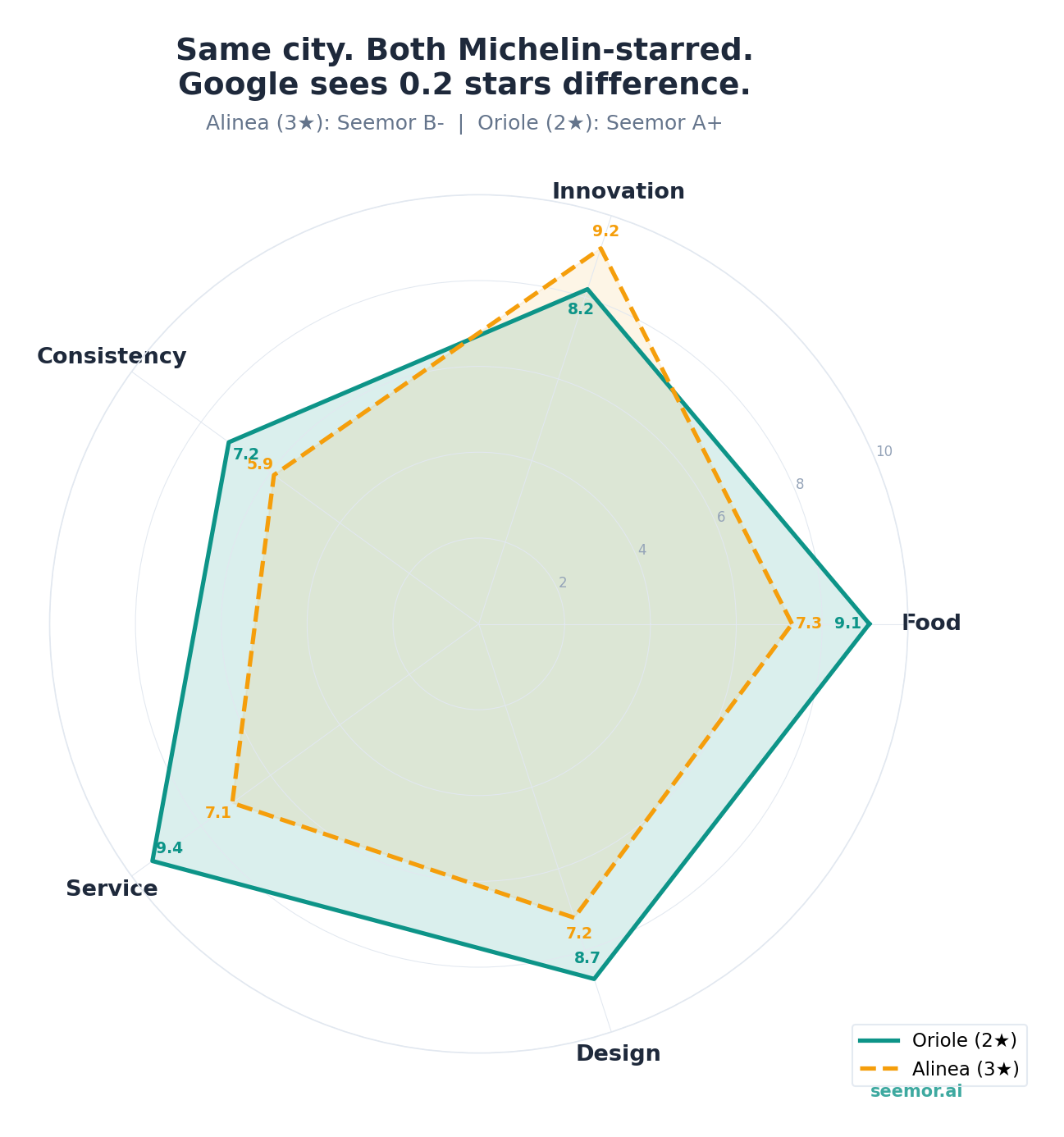
Alinea in Chicago has three Michelin stars and a 4.6 on Google. Oriole, a few miles away, has two stars and a 4.8. On Google, that's a 0.2-star gap. On Seemor, it's 17 points.
We gave Oriole an A+ (score 100). We gave Alinea a B- (score 83).
What 17 points looks like
Seemor on Alinea: "Alinea delivers undeniable modernist theater and creative ambition. However, consistency challenges significantly limit the grade — reports range from life-changing to underwhelming within the same season, with recurring complaints about aggressive salting, temperature issues, and missed service elements."
Seemor on Oriole: "Exceptional contemporary American cuisine featuring pristine seafood and creative global inflections, paired with exceptional service attentiveness. The beautifully orchestrated progression from speakeasy entrance through intimate dining room creates a complete sensory experience."
| Dimension | Oriole (A+) | Alinea (B-) |
|---|---|---|
| Food Quality | 9.1 | 7.3 |
| Innovation | 8.2 | 9.2 |
| Consistency | 7.2 | 5.9 |
| Service | 9.4 | 7.1 |
Alinea wins on innovation. Oriole wins on everything else. Michelin gives Alinea more stars because innovation is what Michelin rewards. Google has no way to show you this.
The bigger pattern
We compared 327 Michelin-tier restaurants against 4,181 equally A-graded non-Michelin restaurants to see what stars actually predict.
| Dimension | Michelin-tier | A-grade Non-Michelin | Gap |
|---|---|---|---|
| Innovation | 7.7 | 5.8 | +2.0 |
| Design | 7.8 | 7.2 | +0.6 |
| Food Quality | 8.5 | 8.1 | +0.3 |
| Service | 8.0 | 7.8 | +0.2 |
| Consistency | 7.1 | 7.2 | -0.1 |
| Value | 7.0 | 7.4 | -0.4 |
| Kid-Friendly | 4.8 | 7.1 | -2.3 |
Two of these dimensions may need explanation. Consistency measures how reliably you'll have a good experience visit to visit (a restaurant that's great on Saturday but disappointing on Tuesday scores low). Innovation measures creative techniques, unexpected flavors, and boundary-pushing presentation.
Innovation is what Michelin measures. The gap is nearly 2 full points, dwarfing everything else. Design and food quality show modest advantages. But consistency, value, and family-friendliness all go the wrong direction.
Michelin-starred restaurants are actually less consistent than equally-rated non-Michelin places. If reliability matters to you, stars are the wrong signal.
One city where it all lines up
Edinburgh's Michelin restaurants are worth noting, briefly, because all three systems agree there. eòrna: Michelin 1 star, Google 5.0, Seemor A+ (103). LYLA: 1 star, 4.8, A+ (100). Condita: 1 star, 4.8, A+ (98). When review quality is high, rating systems can work. We'll explore why Edinburgh is different in a future piece.
A few more across cities
Hélène Darroze, London. 2 Michelin stars, 4.5 on Google. Seemor: A+ (score 100, food 9.1). Our analysis found "exceptional food quality anchored by contemporary French technique," which is the kind of nuance a 4.5 rating simply cannot convey.
Restaurant Gordon Ramsay, London. 3 Michelin stars, 4.4 on Google. Seemor: A- (score 91, food 8.2). Exceptional but with "inconsistent execution on select dishes and tight seating." Three stars doesn't mean perfect. We can tell you why.
Lazy Bear, San Francisco. 2 Michelin stars, 4.7 on Google. Seemor: B+ (score 88, food 8.4). "Quality shifts post-remodel, uneven salt levels, variable dessert execution prevent grade A." Two Michelin stars, but our data says the consistency isn't there anymore.
The honest negative
We gave Alinea, a three-Michelin-star restaurant, a B-. I'm not going to pretend that doesn't make me a little uncomfortable. But a system that can't grade a famous restaurant honestly can't grade any restaurant honestly.
We're not saying Alinea is bad. On innovation it scores a 9.2, which is extraordinary. But on the dimensions most diners actually care about, consistency and service and the odds that your visit will be great, it falls short of its reputation. And I think people deserve to know that before they spend $400.
What this means
Michelin stars reliably predict innovation and, to a lesser degree, food quality and design. If you're looking for a creative, boundary-pushing dining experience, follow the stars.
But if you care about consistency, value, family-friendliness, or whether a restaurant will deliver a reliably great experience on a random Tuesday, Michelin can't help you. Those dimensions aren't part of their framework. They never were.
Explore restaurants mentioned in this article:
See what Seemor finds for you
Honest grades, personal scores, and 35+ dimensions of quality across 12 cities.
Try Seemor free