
What You Actually Get When You Pay More
We scored 14,265 restaurants on 35+ dimensions to see what price actually buys.
From budget to five-star pricing, food quality improves 7.5%. Consistency doesn't improve at all.
We've all had the experience: you spend three times what you normally would on dinner, and the food is... fine. Maybe the room was beautiful. Maybe the service was attentive. But the pasta at the place around the corner was honestly better, and it cost a third as much.
That got me wondering: what does price actually buy you at a restaurant? We looked at 14,265 restaurants across five price levels and scored each one on 35+ dimensions to find out. The answer turns out to be more specific, and more interesting, than "expensive = better."
The numbers
| Price Level | Food Quality | Innovation | Design | Consistency | Speed |
|---|---|---|---|---|---|
| Budget | 7.6 | 4.4 | 6.2 | 6.8 | 7.3 |
| Moderate | 7.6 | 5.0 | 6.5 | 6.6 | 6.9 |
| Expensive | 7.7 | 5.6 | 7.0 | 6.6 | 6.6 |
| Very Expensive | 7.9 | 6.4 | 7.5 | 6.7 | 6.5 |
| Extremely Expensive | 8.2 | 6.9 | 7.8 | 6.9 | 6.6 |
There's a lot in this table, so I'll focus on the four things that surprised me most.
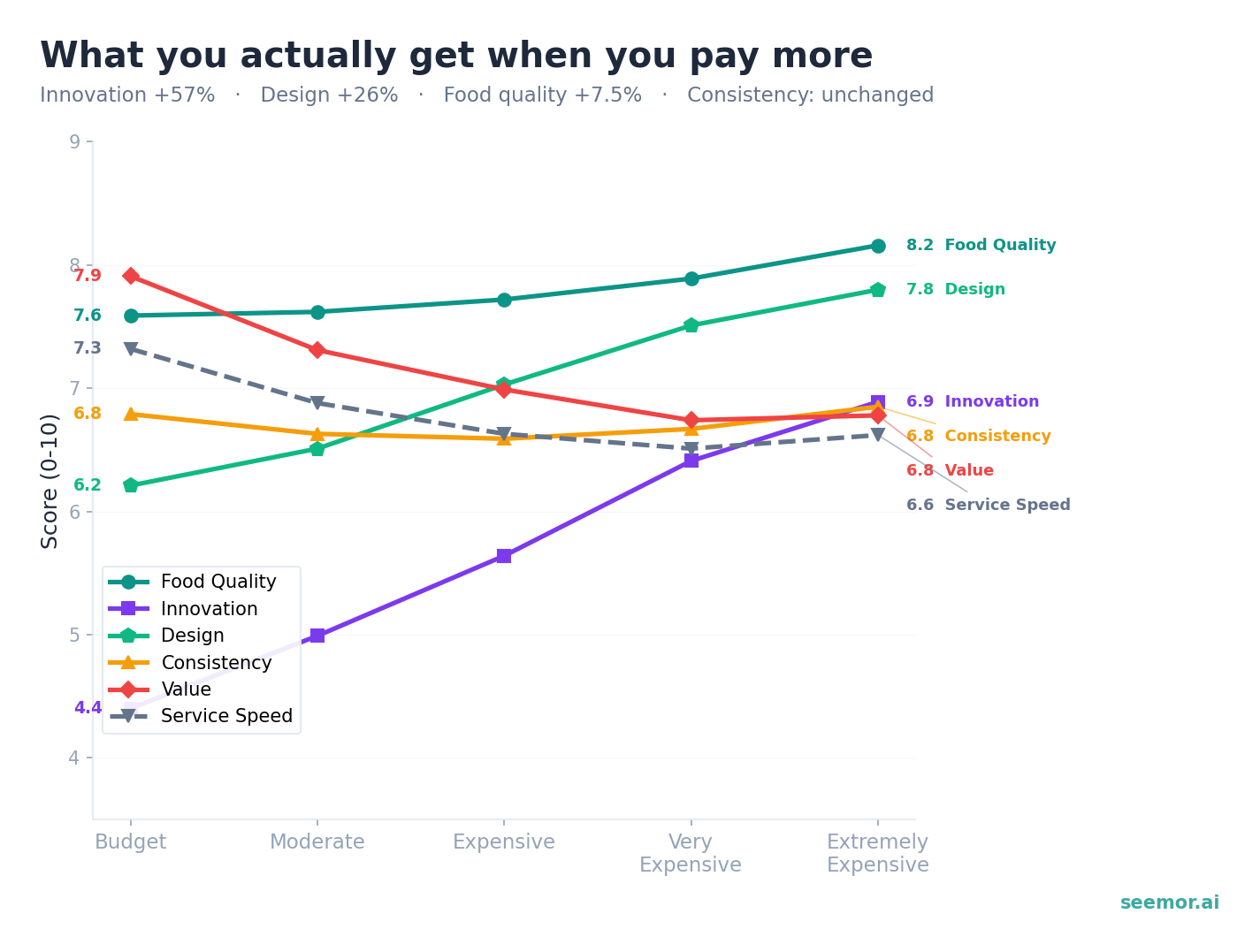
Innovation is what price actually buys
From budget to extremely expensive, innovation jumps from 4.4 to 6.9, a 57% increase. This is the single largest movement in any dimension across the price spectrum.
When you pay more, you're paying for creativity: novel techniques, unexpected flavor combinations, theatrical presentation. The gap between a budget meal and an extremely expensive one is almost entirely about how interesting the food is, not how good it is.
Ambiance and interior design follow a similar pattern, from 6.2 to 7.8. Expensive restaurants look better: more thoughtful interiors, better lighting, nicer tableware. Combined with innovation, this is really the expensive restaurant value proposition: a more creative, more beautiful experience. Whether that's worth 5x the price is a personal question.
Consistency doesn't move
Budget restaurants score 6.8 on consistency. Extremely expensive restaurants score 6.9.
That's a difference of less than 1% across a five-fold price increase. You might assume that paying more buys reliability, that an expensive restaurant is less likely to have an off night. The data says otherwise. A budget spot is just as likely to deliver a consistent experience as a fine dining restaurant.
If anything, consistency actually dips slightly in the middle price ranges (moderate: 6.6, expensive: 6.6) before recovering at the top. The safest bets, consistency-wise, are at the extremes.
Service gets slower
Speed drops steadily: 7.3 at budget level, 6.6 at extremely expensive. You wait longer for every course, every check, every interaction.
Some of this is by design; fine dining meals are meant to unfold over hours. But the data doesn't distinguish between intentional pacing and just plain slow service. What it does show is that if you want an efficient, well-timed meal, cheaper restaurants outperform expensive ones on average.
Service attentiveness does improve with price, from 7.4 to 7.7. Staff at expensive restaurants pay more attention. They're just not faster.
Review trust drops with price
This one is subtle. Review trust, our measure of how reliable and authentic a restaurant's online reviews appear, actually decreases as price goes up. Budget restaurants score 7.7; expensive restaurants score 7.4.
There are several things that could drive this. Higher-end restaurants have more incentive to manage their online reputation. Diners sometimes justify expensive meals with generous ratings (nobody wants to admit a $300 dinner was mediocre). And review platforms themselves can become targets for third-party manipulation that has nothing to do with the restaurant's management. Whatever the mix of causes, the result is the same: the reviews you read about expensive restaurants are, on average, slightly less trustworthy than reviews of cheaper ones.
So what do you do with this
Budget restaurants deliver 93% of the food quality of extremely expensive ones (7.6 vs 8.2). The gap is real but smaller than most people assume. If you care about innovation and creativity, price is a strong signal, and that's genuinely worth paying for when it's what you're after. If you care about consistency, price tells you nothing.
But the bigger point is that dining is about more than food quality. A date night, a business dinner, a quick lunch, a birthday celebration: these are different experiences with different priorities. Sometimes you want creativity and a beautiful room. Sometimes you want great food, fast, for $15. The expensive restaurant isn't "better." It's better at specific things, and now you can see which ones.
Knowing what you're actually buying, and what they're actually selling, is the difference between a great decision and an expensive mistake.
Great food on a budget in London → · Date night restaurants → · Business dinner →
Explore restaurants mentioned in this article:
See what Seemor finds for you
Honest grades, personal scores, and 35+ dimensions of quality across 12 cities.
Try Seemor free